
My 52–48 Senate Forecast
The Senate is currently controlled by Republicans, 53–47. There are 35 seats up for election in this cycle. Only 13 of those 35 are genuinely in play, so we can ignore the remaining 22 seats for purposes of forecasting control.
The Democrats need to “flip” four seats from Republican to Democrat and maintain all of their existing seats in order to take control of the Senate, 51–49. The targets for the four flips are Texas, Maine, Ohio, North Carolina, Alaska, Kansas, Nebraska and Iowa. They also have their eye on South Carolina, but that’s more of a stretch. Including South Carolina, the Democrats have nine target states to get four flips.
We’ll give the Democrats North Carolina and Alaska. That’s two flips. There’s almost no way Democrats will take Nebraska, Kansas, Iowa and South Carolina. That leaves Texas, Maine and Ohio. Democrats would have to flip two out of three to take the Senate. Republicans should hold all three seats, leaving Democrats two seats short of their goal.
It’s worse than that for the Democrats. They also have to hold the seats they have. Three Democratic seats bear watching: Minnesota, Michigan and New Hampshire. All three races are competitive, but the Republicans could well take at least one, maybe two.
If the Republicans take just one — with Michigan being the most likely — that leaves Democrats with a net gain of one seat: two flips minus one loss. The new Senate taking office in January would be 52–48 Republican.
But there’s more to this potential Republican victory than a 52–48 working majority. Five RINOs are being put out to pasture. Mitch McConnell (KY), John Cornyn (TX), Joni Ernst (IA), Bill Cassidy (LA) and Thom Tillis (NC) have all either lost primaries or announced their retirement.
Their departures could make the Republican caucus more MAGA-friendly, although North Carolina, in our forecast, will go to Democrats. So, a Republican 52–48 majority could actually be more able to work with Trump than the current 53–47 majority, which includes those five RINOs.
This is not the forecast you will find in the legacy media or other outlets. A more favorable scenario for Democrats assumes they will hold all of their existing seats (including Michigan, Minnesota and New Hampshire) and flip Maine, Kansas, Ohio and Texas (in addition to North Carolina and Alaska, which we expect). That would be six flips and no losses, giving Democrats control of the Senate, 53–47.
The Blue Wave Meets a Red Wall
Why the divergence between legacy media forecasts and our predictive analytics?
There are two main reasons for this, with numerous factors behind each. The first is propaganda. The media, polling organizations, think tanks, op-ed commentators, late-night comedy and social media influencers are almost united in their hatred of Trump and those who support him.
It’s all you read in The Hill, Politico, The Washington Post, The New York Times and The Wall Street Journal. It’s all you hear on NBC, CBS, ABC and CNN. Even Fox News has joined the crowd.
They have created a narrative that there will be a “Blue Wave” of election results that will cost the Republicans both the House and Senate. Anything that does not support the narrative simply does not get through to the public.
The purpose of the propaganda and news filtering is to discourage Republican voters, suppress turnout and help unpopular Democrats to victory because not enough Republicans will vote.
But there is some evidence that the opposite is happening. Far from being discouraged, it seems Republicans have taken the unending drumbeat of left-wing propaganda as a clarion call.
Election Day may be Nov. 3, but voting has already begun in many states. My sources in Texas report that early voting turnout is highest in mainly Republican precincts, while early voting in Democratic strongholds like Austin is below average for a midterm election.
That’s anecdotal, but it’s good news for Republicans and could be repeated in other close races in Michigan and Minnesota.
It was also reported this week that Mike Bloomberg is directing about $80 million toward Democratic campaigns and allied organizations. It’s his money, and he’s free to do what he wants. But why such a large commitment so late in the game?
It can be read as a sign that Democrats are not doing as well as the media report and that they need a last-minute lifeline from Mayor Mike.
The Three-Point Blind Spot
The second reason is polling. The forecast that the Democrats will take the Senate and the House is based largely on polls. Two prominent names in election polling are RealClearPolling and Trafalgar. We’ll use RealClearPolling (RCP) for purposes of this analysis.
To be clear, RCP does not conduct its own polling. It publishes polling averages drawn from surveys by organizations including The New York Times, Trafalgar, CNN, Fox, CBS and Rasmussen. Some are better than others, but the averaging methodology is intended to filter out the noise and give a more reliable result.
In the close Senate races, RCP shows Democratic leads as follows:
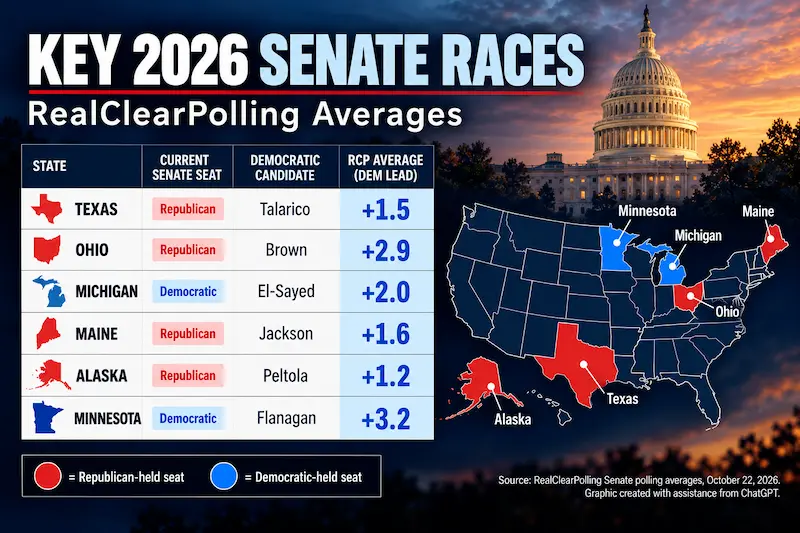
If those polls were to hold in the final results, Democrats would indeed flip five states (Texas, Ohio, Maine, Alaska and North Carolina) and hold all of their current seats (including Michigan, Minnesota and New Hampshire). The result would be a Democratic-controlled Senate, 52–48.
The reality, in my view, is that the polls are badly flawed. The pollsters know about many of the flaws but don’t seem concerned. I believe the skewed results that favor Democrats are part of the overall anti-Trump propaganda campaign. Who cares if your reputation as a pollster is damaged as long as Democrats win?
The potential polling flaws are clear. Pollsters can oversample Democrats relative to the overall voting population. They sometimes use small sample sizes, which increase the margin of error. They may oversample African Americans, college-educated voters and women. Without proper weighting, those skews can favor Democrats.
It gets worse. There is evidence that conservative Republicans are less willing to answer pollsters’ calls. Democrats may be more willing to chat and answer lots of questions. (Maybe because they think they’re smarter than we are.) Republicans have better things to do.
And because of the propaganda, many Republicans may not give honest answers even if they do talk. They may be reluctant to admit they favor MAGA-type Trump candidates. But they still vote for them at the ballot box.
When you take all of these factors into account, my estimate is that the polls could overstate Democratic leads by about three percentage points.
If you shift the Democratic margins in the above RCP averages three points toward Republicans, that puts Republicans ahead in Texas, Ohio, Michigan, Maine and Alaska, with Minnesota much closer.
Under this more favorable Republican scenario, if you add Kansas, Iowa, South Carolina and Nebraska to the Republican side, that gives Democrats one pickup (North Carolina) and one loss (Michigan), for a net gain of zero. The Senate would remain 53–47 Republican.
We’ll be back next week with updates on the Senate races and a deep dive on the House elections. The consensus is that Democrats will take control of the House. But my models show an extremely close race, with a decent chance that Republicans can hold their majority.
The stakes go well beyond which party controls Congress for the next two years. The 2028 presidential race will begin the day after these midterms, and Trump will immediately be labeled a lame duck. (Whether he acts like one is another matter.)
With just twelve days until Election Day, the outcome is far from settled. These could be among the most consequential midterm elections of our lifetimes.
All the best,

Jim Rickards
Editor, Strategic Intelligence